Register on Eventbrite
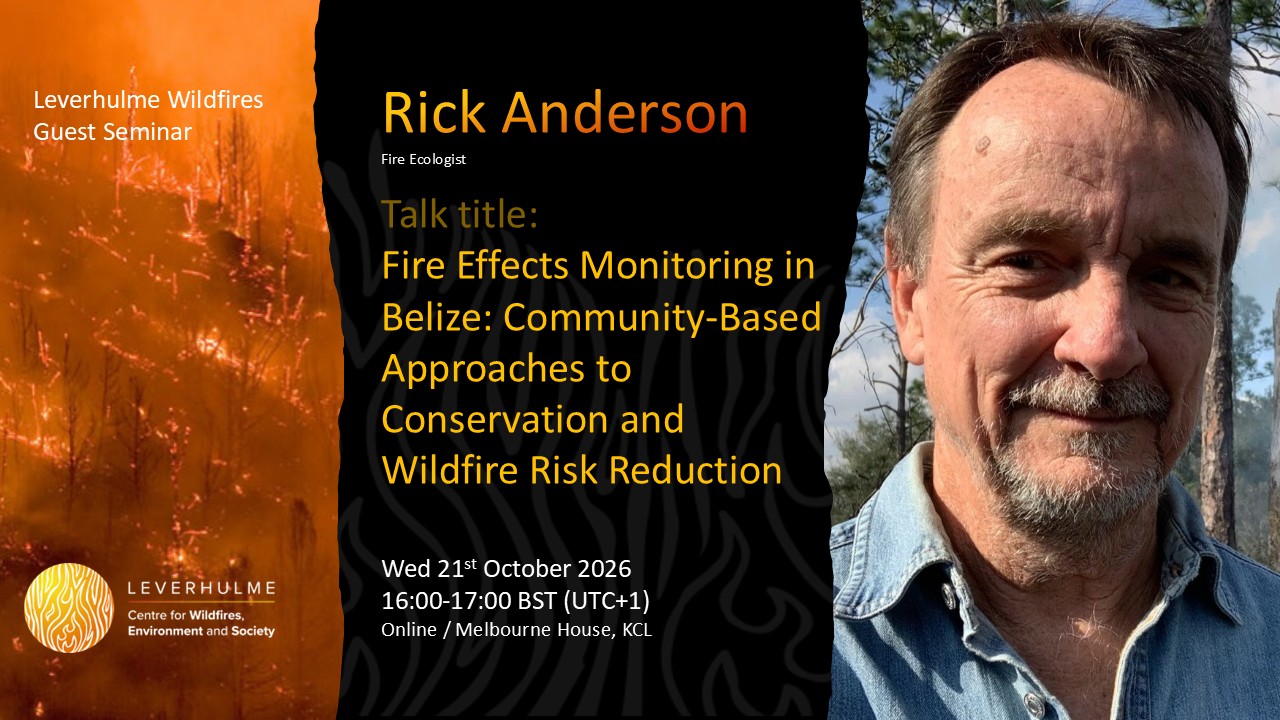
Wednesday 21st October 2026, 16:00-17:00 BST (UTC+1)
MS Teams/ KCL Melbourne House 6th Floor boardroom (for Centre/ KCL members)
Title: Fire Effects Monitoring in Belize: Community-Based Approaches to Conservation and Wildfire Risk Reduction
Speaker: Rick Anderson
Abstract
Community-based fire monitoring offers a practical approach for improving wildfire management in regions where ecological data and institutional firefighting capacity are limited. Payne’s Creek National Park (PCNP) in southern Belize is a critical conservation landscape linking the Maya Mountain Conservation Corridor to coastal ecosystems. Its pine woodlands and savannas provide important habitat for the Endangered Yellow-headed Parrot (Amazona oratrix), while adjacent communities depend on surrounding forest resources for their livelihoods.
Increasing fire use for agriculture and wildlife management, combined with growing human pressures, has led to more frequent and extensive wildfires that threaten communities, biodiversity, and ecosystem services. In response, the Darwin Initiative project, Conserving Pine Woodland Biodiversity in Belize through Community Fire Management, supported the development of community-based fire effects monitoring to evaluate fuel management practices and wildfire impacts in pine savanna and adjacent broadleaf forest ecosystems.
Community members, Toledo Institute for Development and Environment (TIDE) staff, and fire ecologists collaborated to develop practical monitoring protocols and assess management outcomes. Caribbean pine (Pinus caribaea), palmetto (Acoelorrhaphe wrightii), and cycad (Zamia prasina) were selected as focal indicators because of their ecological importance and socioeconomic value.
This case study demonstrates how community-based fire effects monitoring can improve understanding of fire impacts, support adaptive management, and reduce wildfire risks to both conservation values and local livelihoods. The project highlights the value of citizen science and practitioner-led monitoring in data-limited tropical ecosystems and provides a model for integrating conservation objectives, community participation, and wildfire resilience. When local knowledge is combined with scientific monitoring, communities become not only stewards of the landscape but also essential partners in building a more resilient future for both people and biodiversity.
Speaker Bio
Rick Anderson is a fire ecologist and international consultant specializing in integrated fire management in tropical wetlands, savannas, and forests. Holding a Master’s degree from the University of Montana, they served in seven U.S. National Parks, including Yellowstone and Everglades National Parks, before retiring from federal service to support the United Nations and other international agencies on fire management, conservation, and climate resilience.
His work focuses on the intersection of fire, biodiversity, air and water quality, and the wellbeing of Indigenous Peoples and rural communities that depend on fire-shaped ecosystems. Drawing on experience in Belize and across Central America, they address fire management challenges rooted in climate change, land-use change, weak governance, and the enduring legacies of colonialism.
A descendant of Florida’s earliest pioneer families, whose fire traditions originated in Scotland and evolved through interaction with Indigenous fire stewardship practices, they bring a unique perspective that bridges science, culture, and on-the-ground experience. Their work advances collaborative approaches that integrate ecological science, traditional knowledge, and community leadership to build more resilient landscapes and societies.
He resides at Palmetto Island Ranch in Venus Florida.
Leverhulme Wildfires Guest Seminars
The guest seminar is organised by the Leverhulme Centre for Wildfires, Environment and Society Each seminar involves 30-40min of a speaker presentation, followed by opportunity for Q&A and discussion.
Some of our past webinars can be viewed on our youtube channel.
The Leverhulme Centre for Wildfires, Environment and Society is a collaboration between Imperial College London, King’s College London, Royal Holloway, and the University of Reading.
Any queries, please contact wildfire@imperial.ac.uk