
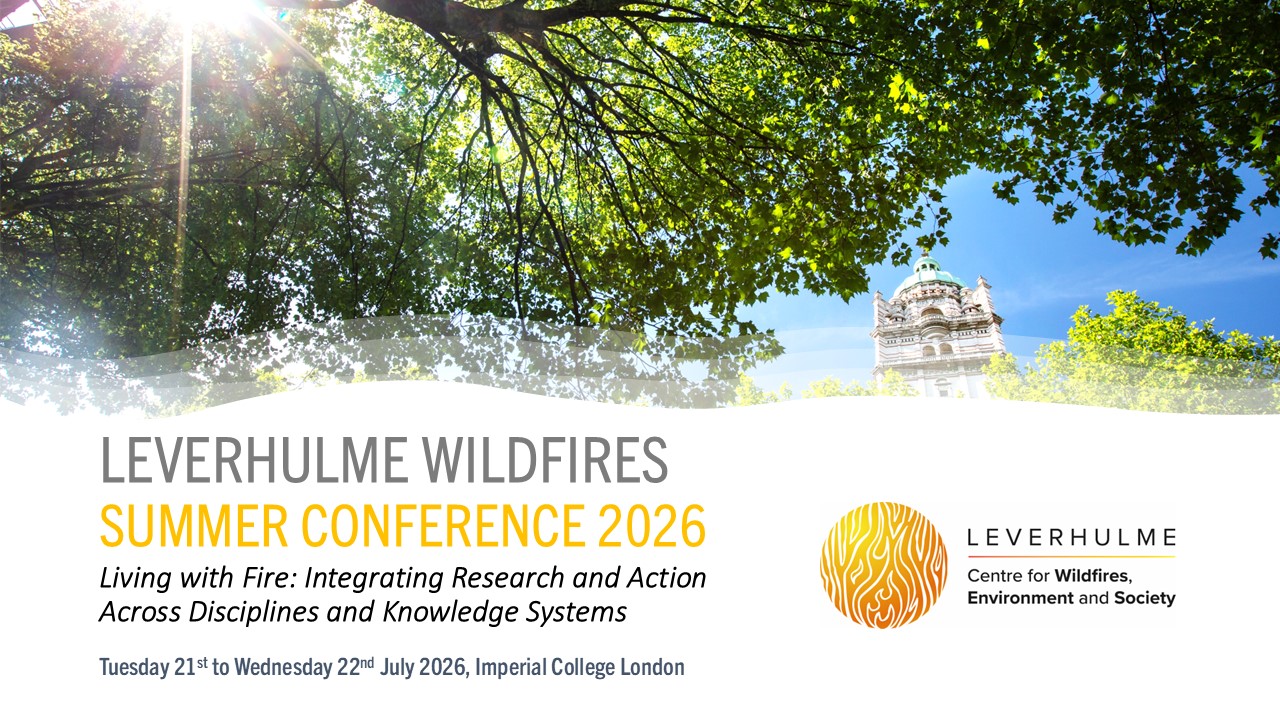
Leverhulme Wildfires Summer Conference 2026
Living with Fire: Integrating Research and Action Across Disciplines and Knowledge Systems
The international conference of the Leverhulme Centre for Wildfires, Society and Environment (“Leverhulme Wildfires”)
Imperial College London
Tuesday 21st July and Wednesday 22nd July, 2026
City and Guilds Building, South Kensington
Conference Summary
The Leverhulme Wildfires Summer Conference 2026 brings together researchers, policymakers, practitioners and other experts from diverse disciplines to share our understanding of landscape fires, their drivers and impacts – and explore how societies can live with fires in a rapidly changing Earth system.
Through a mix of presentations, panel discussions, workshops and interactive sessions, participants will examine the drivers and impacts of changing fire regimes and explore how scientific insight can better inform action. The programme highlights emerging approaches to proactive preparedness, advances in fire detection and prediction, and the need for inclusive and equitable fire management that integrates scientific, Indigenous and practitioner knowledge. It also considers how adaptive policies, governance arrangements and economic incentives can support more resilient landscapes and communities.
By fostering dialogue across disciplines and knowledge systems, the conference aims to identify practical pathways for integrating research, policy and management in order to navigate the complex ecological and societal challenges posed by fire.
Read below for information on:
🌿 Conference Themes
📜 Full Programme and Agenda
🎨 Wildfire Art Exhibition
🍕 Pizza and Movie Night
📸 Photography Competition (Wildfires Research Through the Lens II)
📆 Registration [Registration closed] and BBQ dinner [booking closed]
🌎 International Travel Bursary [Call closed]
🔊 Call For Abstracts [Call closed]
✉️ Organising Committee and Contact Information
Conference Themes
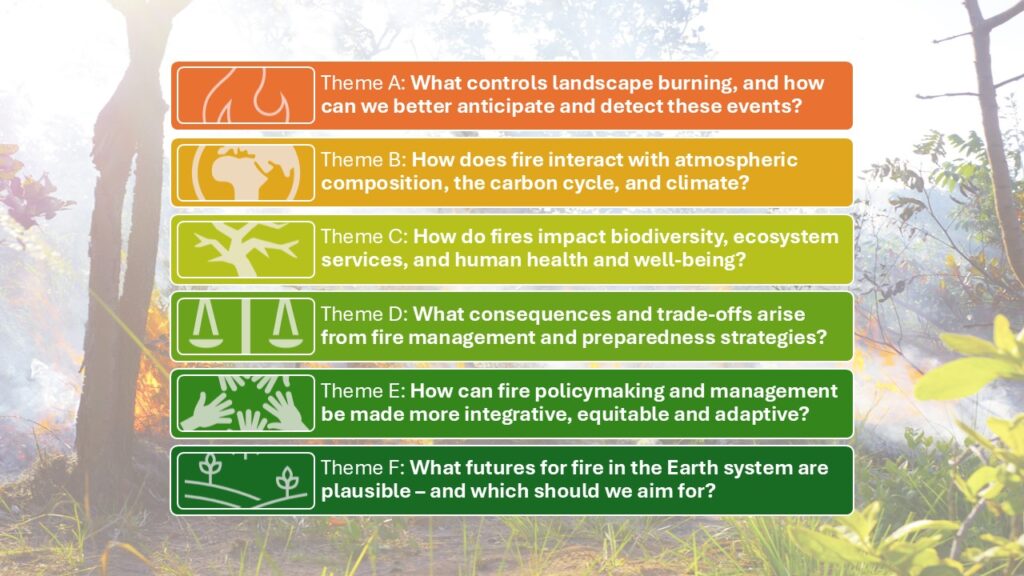
Theme A: What controls landscape burning, and how can we better anticipate and detect these events?
What are the relative roles of climate variability, long-term climate change, vegetation and fuel dynamics, and human activities in shaping fire regimes? This session explores drivers of fire across scales – from laboratory experiments and local landscape processes to global Earth system patterns – and considers how improved observation, detection, and predictive capabilities can support earlier awareness and proactive preparedness.
Theme B: How does fire interact with atmospheric composition, the carbon cycle, and climate?
As fire regimes intensify and shift, how do they alter atmospheric chemistry, air quality, carbon cycling, weather patterns, and long-term climate trajectories? And how do climate and weather, in turn, impact fire regimes? This session examines both present-day feedbacks and their implications for future Earth system dynamics, including how improved monitoring and modelling of fire–atmosphere interactions can enhance prediction and societal preparedness for emerging risks.
Theme C: How do fires impact biodiversity, ecosystem services, and human health and well-being?
Fires reshape habitats, species interactions, ecosystem services, and the health and livelihoods of communities. This session explores ecological and social consequences of fire, identifying vulnerabilities, thresholds, and opportunities for resilience, with particular attention to how impacts and risks are distributed across societies and landscapes.
Theme D: What consequences and trade-offs arise from fire management and preparedness strategies?
Efforts to suppress or control fire often have unexpected social and ecological knock‑on effects, producing difficult trade‑offs among competing policy objectives and social values. This session seeks to clarify those trade‑offs and evaluate the effectiveness of proactive preparedness and management approaches, and considers their implications for long-term environmental and societal resilience.
Theme E: How can fire policymaking and management be made more integrative, equitable and adaptive?
Fire policymaking must navigate competing goals, interests and knowledge systems in ways that are perceived as fair and that produce effective outcomes. This session explores how policymaking and management can better integrate ecological and social sciences, Indigenous and local knowledge, and practitioner expertise to improve decision‑making, legitimacy and measurable social and ecological outcomes, while also examining the role of adaptive governance and economic instruments, including markets, in shaping fire management strategies.
Theme F: What futures for fire in the Earth system are plausible – and which should we aim for?
This session examines plausible trajectories of fire–climate–landscape interaction under alternative climate change, economic development and governance scenarios. It considers how advances in prediction, preparedness, and adaptive policy frameworks could shape future fire regimes, and asks what normative visions of a “good” fire future (for safety, biodiversity, carbon and cultural livelihoods) should guide policy and how they might be achieved.
Agenda and Conference Programme
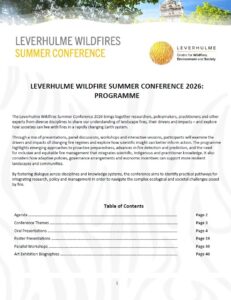
Please see our Full Programme here, including the agenda, abstracts for oral and poster presentations, information on the parallel sessions, and the art exhibition biographies:
Leverhulme Wildfires Summer Conference – Full Agenda and Programme 17.07.26
Wildfire Art Exhibition
We are delighted to present a wildfire art exhibition as part of the conference programme. Bringing together a diverse range of creative works, the exhibition explores different perspectives on wildfire, landscapes, people, and environmental change.
We are also pleased to share that the Exhibition Catalogue is now available. The catalogue provides additional context on the exhibition and its contributors, exploring the ideas, stories, and creative processes behind the works on display. We hope it will enrich your experience of the exhibition during the conference and serve as a lasting record of the project
Art Exhibition Catalogue – Leverhulme Wildfires 2026

Exquisite Corpse – Jay Mistry, We Are Fire; Matt Kasoar, Campfire Bloom; Cathy Smith, Phoenix
Pizza and Movie Night

Where: Imperial College London – Physics Lecture Theatre 1, Blackett Laboratory
When: Monday 20th July, 6:00pm -8.15pm
Agenda
-
6:00-6.30 pm Arrive and Register
-
6:30–7:00 pm Film 1: REIGNITION: Bringing Good Fire Back to the Land (Canada); Film 2: Farmers and Fire: Local Efforts in Dealing with Wildfires in Peru
-
7:00–7:30 pm Pizza break and networking
-
7:30–8:00 pm Film 3: Gidiku Vapathu: Going to the Forest (India)
-
8:00-8:15 pm Discussion and wrap-up.
ECR Photography Competition
“Wildfires Through the Lens II”
In association with the Leverhulme Wildfires Summer Conference 2026, we are running competition to find photographs and accompanying narratives that best communicate the impressive work of Early Career Research (ECRs) studying wildfires.
Conference attendees and the public are invited to vote for the People’s Choice award worth £150!
Please visit the dedicated competition page here.
TO VOTE (voting closes at 4pm BST, Wednesday 22nd July) – please fill in the form here.
International Travel Bursary for Early Career Researchers and PhD Students

We have made two full bursaries available to Early Career Researchers (ECRs) (up to 8 years post-PhD) and PhD students from least developed, low, and lower middle-income countries, as defined by OECD
Full bursaries include: international travel to London, UK; visa costs; and accommodation and subsistence over the conference period. We have also supported a limited number of partial bursaries, covering accommodation, visas and travel/subsistence within London.
Selection decisions relied chiefly on the Statement of Support and the presentation abstract, with additional preference afforded to applicants from least developed countries.
ECR TRAVEL BURSARY APPLICATION(now closed)
Successful applicants will give an oral or poster presentation at the conference.
Deadline: 20th April 2026 (closed)
Registration
Registration was via Eventbrite and is now closed. Those who have registered via Eventbrite will receive information about the conference via email.
Registration for our two-day conference, including lunches and refreshments, was entirely free, to allow for a more inclusive and accessible conference.
The only exception is the BBQ dinner at £45pp including drinks (booking now closed). This BBQ is offered on a non‑profit basis and is further subsidised by Leverhulme Wildfires.
Deadline for registration was Friday 9th July
Call for Abstracts (closed)
The Call for Abstracts is now closed. Following this successful call, we can confirm we have 30 speakers and almost 50 posters at the conference.
We invited abstracts for presentations (oral or poster) from researchers, practitioners and other experts under our six key themes. We also invited applications to exhibit artworks at the conference, that address the question: How can art help us perceive, understand, and reimagine fire in a rapidly changing world?
The Call closed on 20th April 2026.
If you are interested in holding a wildfire-related meeting on the post-conference morning, Thurs 23rd July, please get in touch.
Conference Organising Committee
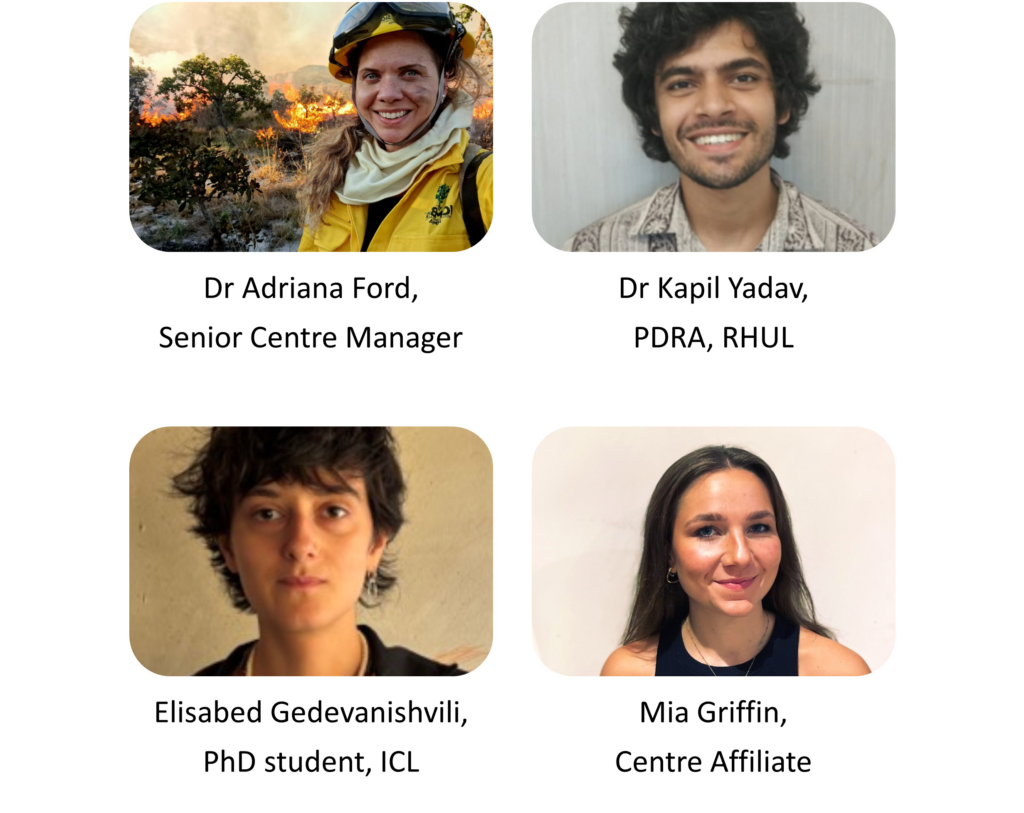
For information please contact Adriana Ford at wildfire@imperial.ac.uk