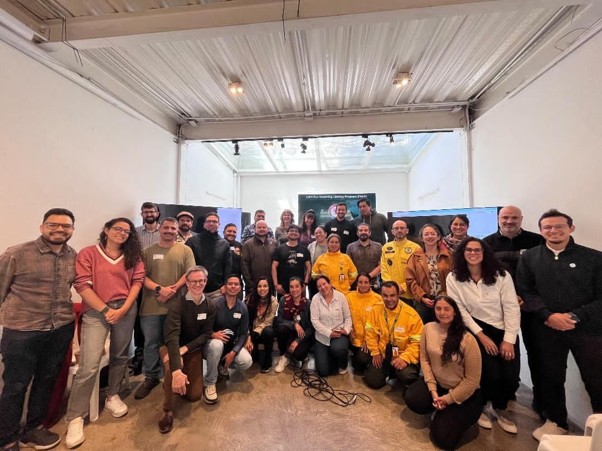
On the 14th and 15th October, Michel Valette, a researcher at the Leverhulme Centre for Wildfires, Environment and Society, co-chaired two sessions at the first workshop of the Fire Modelling Literacy Program in Bogotá, Colombia. Led by the Global Wildfire Collective (GWC), a program of the Conservation Biology Institute and a partner organisation of the Centre, the programme reached a major milestone with this first regional event.
As fire models multiply, practitioners need help choosing the right one for their question, understanding what it can tell them and judging how uncertain it is. The programme aims to build the capacity of academics, government staff, land managers, private companies, firefighters and conservation practitioners to understand, critically assess and use fire models. Its tiered design starts with a foundation module covering the main classes of fire model, the steps of the modelling workflow, sources of uncertainty and how to evaluate outputs. Real cases of models used in management decisions keep the learning grounded in practice. Later modules will turn to applications such as ignition and spread, hazard and vulnerability, and fire simulation.
The Centre has supported the programme by promoting GWC activities, connecting GWC with presenters, giving feedback on the workshop’s structure, participating in GWC webinars and taking part in this first workshop of the Fire Modelling Litteracy Program.
The workshop brought together 41 participants from seven countries, representing academia, NGOs, the private sector, fire brigades and government institutions. On day one, Dr Alexandra Syphard gave a comprehensive lecture on the foundations of fire modelling. Break-out groups then identified a fire management problem and proposed a modelling approach to address it. Their proposals ranged from wildfire risk models for urban contexts to smoke-exposure models at national scale, showing how varied operational needs are across South America.
On day two, Michel co-chaired a session on participatory modelling and co-design with practitioners and communities, together with Dr Renata Veiga (UFRJ). Drawing on his research on adaptation to wildfire risk in Capoto/Jarina, he presented the benefits of participatory approaches and methods for putting them into practice. Dr Veiga followed with a talk on recent fire policy changes in Brazil and on using participation to refine climate attribution analysis. Including local ecological knowledge is especially important in hyper-diverse ecosystems such as the Amazon rainforest and Los Llanos savanna, where the diversity of fire ecologies is hard to capture with conventional modelling.
Michel also co-chaired a session on early warning, monitoring and operational decision-making, co-led by Markristian Madariaga Pareja of Peru’s General Volunteer Fire Department and Forest Fire Response Program. This interactive roundtable brought together fire brigades and managers from Colombia, Peru, Brazil and Ecuador to compare the information they rely on. Three points stood out:
- information systems are uneven and diverse across countries;
- legal constraints outside Brazil prevent some wildfire risk prevention activities;
- well-designed, locally adapted dashboards can meet practitioners’ needs effectively.
The workshop and the wider programme connect practitioners, academics and policymakers. Keeping applied research linked to policy and practitioner needs is central to the ethos of both the Centre and the GWC, and essential for responding to fast-changing fire regimes and the escalating threat of wildfires.
Photo credit: Global Wildfire Collective